


Design a Fan Assisted Heat Sink to reject 140W form Desktop Computer | 2019
- Nirosh Jayasuriya

- May 31, 2020
- 1 min read
Updated: Jun 7, 2020
University of Moratuwa, Supervised by Dr. M. Anusha Wijewardane
The requirement for thermal management in high-performance computers are major concern in the power electronics sector. The main reasons for thermal management are higher average chip power density, higher peak power densities in chip hotspots & more stringent system boundary conditions. Mainly there are two kinds of cooling solutions which are active cooling and passive cooling. Most of the passive cooling systems use natural convection while active cooling systems use forced convection methods. With the increment of higher average chip power density in present electronic systems, it is essential to go for an active cooling method to gain maximum effectiveness of chipset.
Most of the semiconductor industries are taking extraordinary effort over the past decades to reduce the size of the electronic devices. With the increase in power dissipation and reduction in the size, the expected power dissipation in future devices will be in considerable range. Approximately 55% of failures in electronic devices are happening due to temperature increment. That’s why it is essential to give major attention to thermal management systems in power electronic devices.
In here our main consideration is active cooling techniques which offer high cooling capacity. Air/liquid jet impingement, spray cooling thermoelectric coolers, forced liquid convection and refrigeration systems are some of example for active cooling techniques. Due to some limitations, phase change material (PCM) and heat pipe technologies are rapidly used to achieve high cooling capacity in electronic package cooling systems.
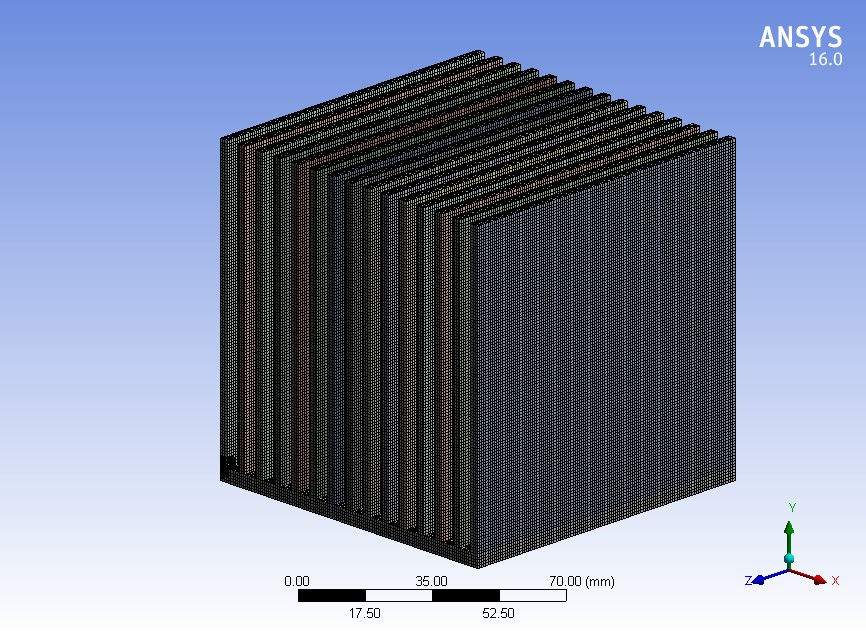
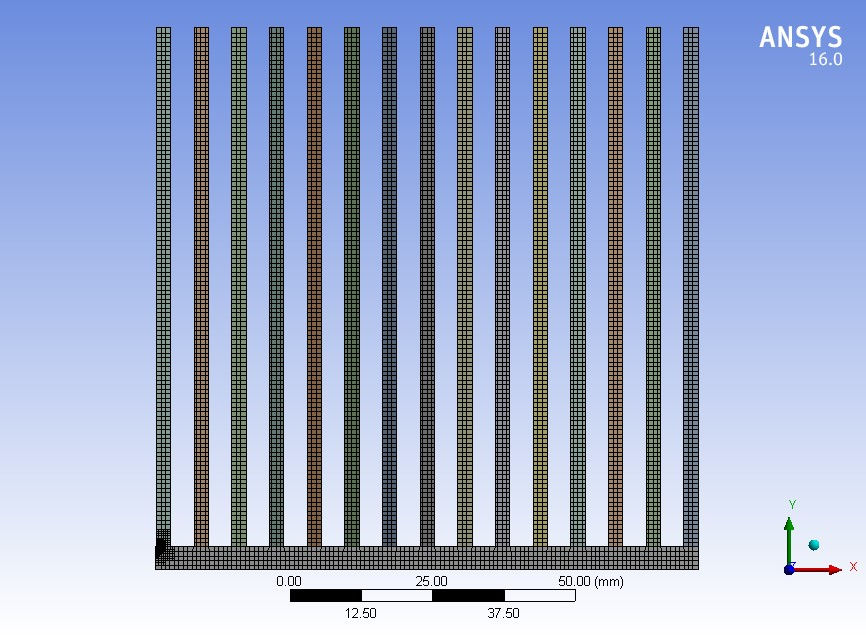
According to satisfy all the requirements heat sink was designed. To validate numerical calculation CFD (Ansys Fluent) was used. Some of simulation results are shown below.


Comments